The River
“We’d go down to the river, and into …”
We were indeed driving down to the river belting out my favourite Springsteen song when my husband suddenly broke off. “Wait! Is that a croc hiding in the water?” I tried to see what he was pointing at. “It could be. After all, we’re not that far from Crook’s Corner where we saw that big one.”
We stopped the car and reconsidered. It had seemed such a good idea, back home. Instead of crossing to Zimbabwe through Beitbridge, South Africa’s most-dreaded border post, we would take the scenic route through Mozambique. After all, most of it was on good tarred roads, and the shortcut using a dirt road hugging the Zimbabwe border was said to be in good condition. Even driving through the legendary Limpopo river was supposed to be easy.
And until now, everything had gone smoothly. My prep work had paid off, we had even made sure we finished all the beer to avoid hassles with Mozambique Customs. We had found the great grey-green greasy Limpopo and were all set for our first African river crossing. But none of my guides said anything about beating off crocodiles.
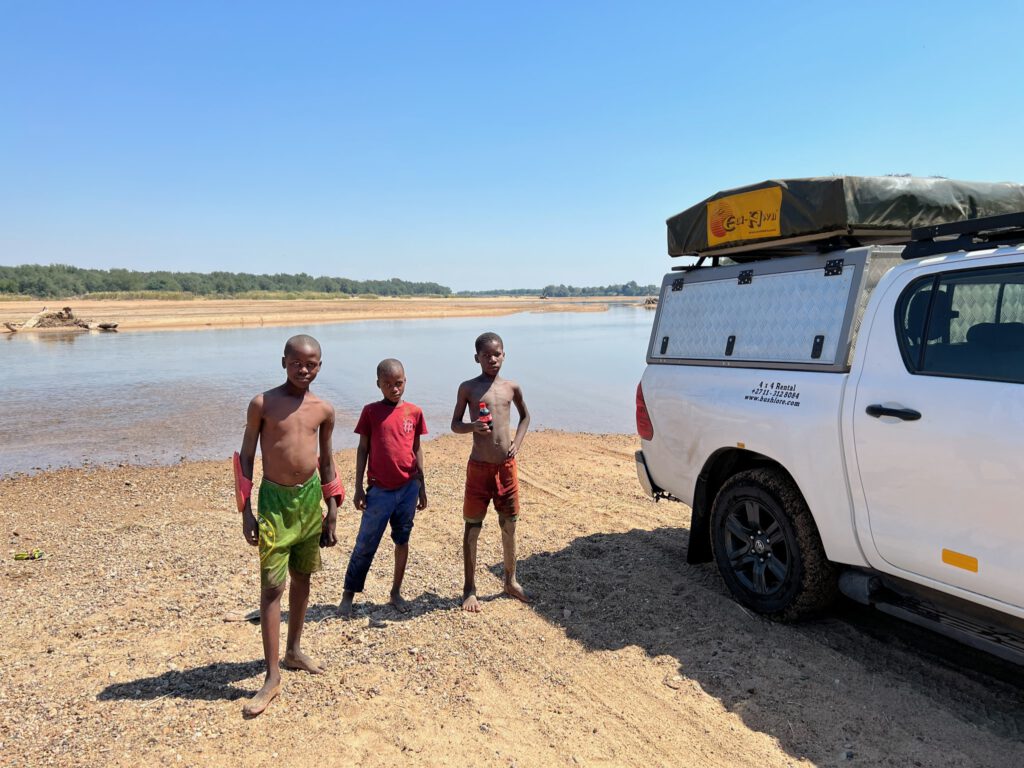
Suddenly, while we were checking a detour that would get us to an actual bridge, some children appeared. They were barefoot, smiling broadly and waving for us to follow them. We shared a long look, “What the heck, let’s go” and drove down the dry riverbed to the boys splashing in the shallow waters. They pushed a big log out of our way and waded to the other side, with the Hilux following closely. The safe crossing called for celebration, but with a long drive still ahead we thanked our heroes, shared some cold soft drinks with them and pushed on.
After bouncing for hours on the rough track that was not quite as good as I had been led to believe, we finally got to the border in dusty Chiqualaquala. We were seriously behind schedule by now and worried about getting in before dark. We could also smell bushfire and a large plume of smoke appeared to be between us and Mabalauta, destination for the day, where we would start six days of roughing it in Gonarezhou, Place of the Elephants.
The friendly Immigrations officer told us not to worry about it. “You’ll be fine. It’s not a bushfire, they are removing landmines that were left over from the civil war. As long you stay on the roads, nothing will happen.” Suddenly I understood why there had been tape tied to the trees and felt quite relieved about not relieving myself behind a tree earlier. Even though I hadn’t made the connection, the hazard signs in our trusty navigation app had proved to be quite useful.
When sunset still saw us crawling along the African veldt, I was less sure about the app. It showed an off-road track that was supposed to lead us to camp, and it matched the car tracks in front of us, but with a notice saying ‘road closed, turn back and follow the signs’ we were clueless. Did we miss a turnoff when we were so excited about the pangolin we spotted? Admittedly, it was only his unmistakable rear end, but still.
And indeed, the sign was there. Paint peeling off, and the words almost completely faded away, but we could still make it out. ‘Turn left to Mabalauta camp site, 2 km’. With our driving speed not fully up to African standards and certainly not in pitch dark, it was another twenty minutes before we were warmly welcomed by the ranger. Our ETA had been radioed through from the park gate, and he had been waiting for quite a while, unsure what was keeping us. Deciding not to launch into a long tale, we bought some firewood and drove off to make camp.
10 pm saw us finally settled with a nice South African red, enjoying the sounds of elephants drinking from the river below. It was the perfect way to wind down after a full day, but I felt sure we hadn’t even scratched the surface of this remote corner of Africa.
Note: this blog was originally submitted as an entry for the 2022 Bradt travel writer competition